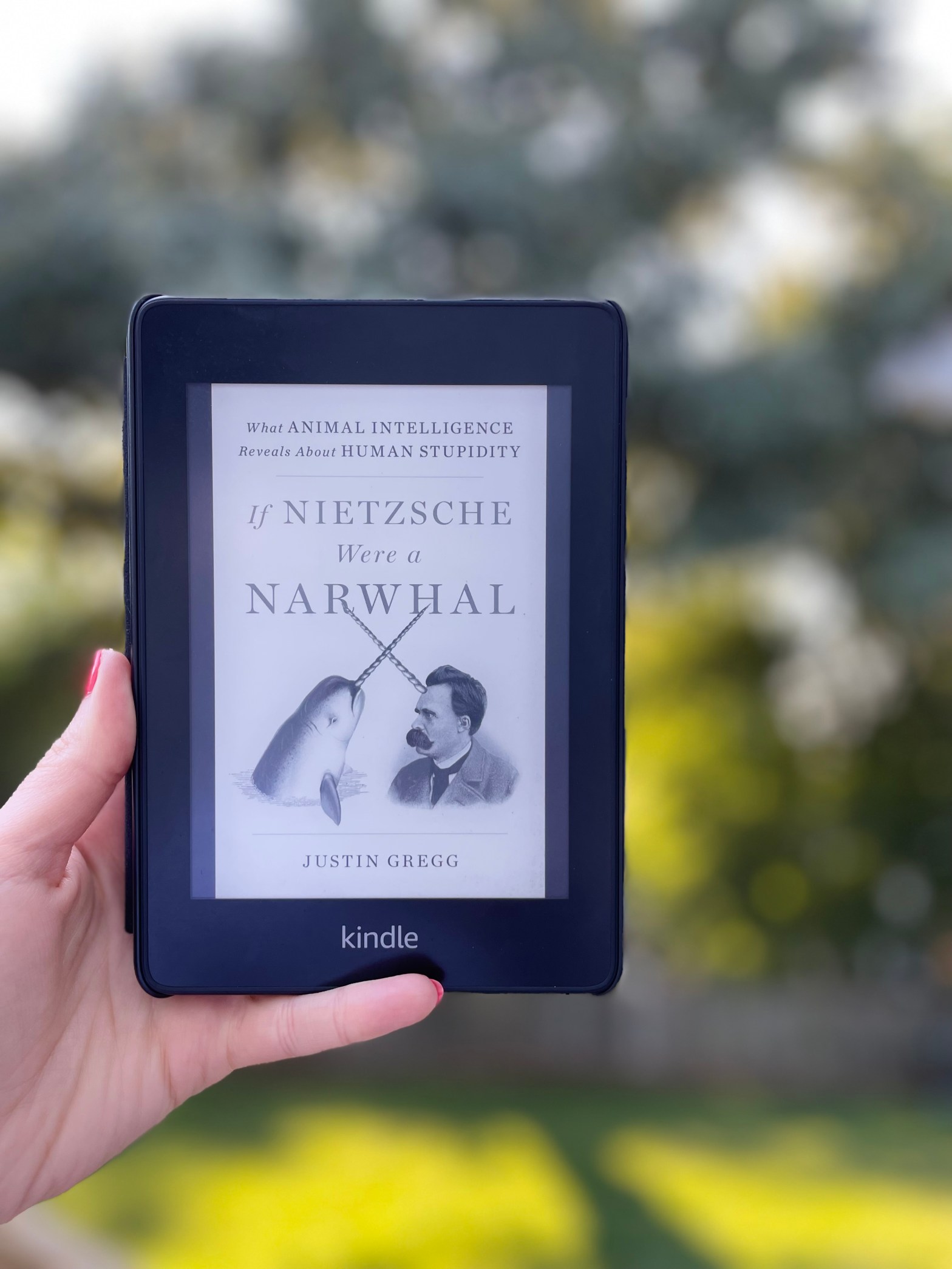
Title: If Nietzsche Were a Narwhal: What Animal Intelligence Reveals About Human Stupidity
Author: Justin Gregg
Genre: Nonfiction, Science
Published: 2022
Pages: 214 (Kindle Edition)
Goodreads Rating: 3.90
Rating: 6/10
“In the grand scheme of things, we are destined to vanish from the Earth long before either bacteria or crocodiles.”
In If Nietzsche Were a Narwhal, strap in for an anxiety-inducing rollercoaster ride through history as the author highlights some of humanity’s worst failures while teaching you a thing or two. Do non-human animals live a simpler life? Undoubtedly. Are humans to blame for most of the planet’s environmental issues that wreak havoc on other species? Sure. Is humanity capable of developing a pleasurable world for everyone and we’re just failing to do so? … Debatable. Join Gregg as he unabashedly criticizes humanity in favor of a non-human level of cognitive ability. Would it be better if we were all narwhals? Read and find out.
Pros:
Prognostic myopia amongst other things
There’s no denying that this book is educational. I learned about many things including… prognostic myopia and why “it is the most dangerous flaw in human thinking”, that scientists don’t know why humans have chins, and what the hell happened in Canada. Get ready to be mesmerized, disturbed, shocked, and horrified… all in the name of education.
Examples to help explain prognostic myopia amongst other things
There are a lot of complex topics throughout the book… but Gregg does a fantastic job of providing examples to help explain these concepts. (More on his choice of examples later…) For me, the most helpful is his approach to explaining our cognitive capability using improv actors on a stage.
Makes you use that thought cage
At times, this book can be pretty disturbing and it makes you think hard about issues where humans are failing our planet. But I hope that the awareness this author brings to tough topics and all of the deep thought generated by this book leads to positive change. Will I make any lifestyle changes after reading this book? I certainly plan on it. Chapter six was an especially impactful chapter that made me reconsider many things including my approach to my lawn and the animals in it.
Cons:
This book is depressing.
This author is a real negative Nancy. Gregg takes an exceedingly pessimistic view of humans including our morals, intellect, and “why” mentality. In his view, humans are “death, the destroyer of worlds” (not his words) and we, as a whole, would all be better off without humans’ “additional cognitive sprinkles” (definitely his words).
Back to those examples…
I think Gregg would be a great cherry picker because he certainly proved his literary cherry picking talent in this book. Two things can be said about this author… he is accurate and one-sided. His book is filled with selective examples to prove his point and he does a poor job of referencing the positive impacts that humans have had on the planet because those would be examples that would weaken his point. Are we perfect? Of course not. But we are also not a species with zero admirable qualities.
Simply put… I disagree with his outlook.
While reading this book, please do not forget the accomplishments of our species. Vaccines, farming, life expectancy improvements, organ replacements, medical technology that allows the blind to see and the deaf to hear… Again, are we perfect? No. But we have certainly not failed as miserably as Gregg would have you believe.
To show that I learned a thing or two from Gregg, I’ll provide an example…. DDT. DDT is an insecticide that was used to treat bed bug infestations in the United States in the early 1900s and it was used with reckless abandon. At one point, Gregg says, “thinking too hard about things isn’t necessarily doing anyone any favors.” With DDT, I completely disagree. If we had thought harder before using DDT as aggressively as we did, we could have considered the scenarios and potential consequences of DDT. Maybe we could have tested it out and observed the impact on the environment. Maybe the government could have provided a rollout plan with scientists and researchers before using it as the be-all-end-all approach to bed bugs. Maybe we should have considered the “thousand-year conclusion” before condemning future generations. Instead, we seemed to use it without hesitation and are still dealing with the negative consequences today. Perhaps our issue is not our “amazing, complex intelligence” but the lack of an international, governmental, systematic approach to force us to apply that intellect to future potentials.
Overall…
I’m conflicted with this book. It feels like Gregg intentionally went to the extreme to try to have the reader meet him in the middle. To achieve a small percentage of change, he had to aggressively push his pessimistic mentality… Or at least that’s what I’ll tell myself. Did I enjoy this book? Debatable. Did I learn many valuable concepts? Absolutely, and I feel better off for it.
 Caroline’s Library